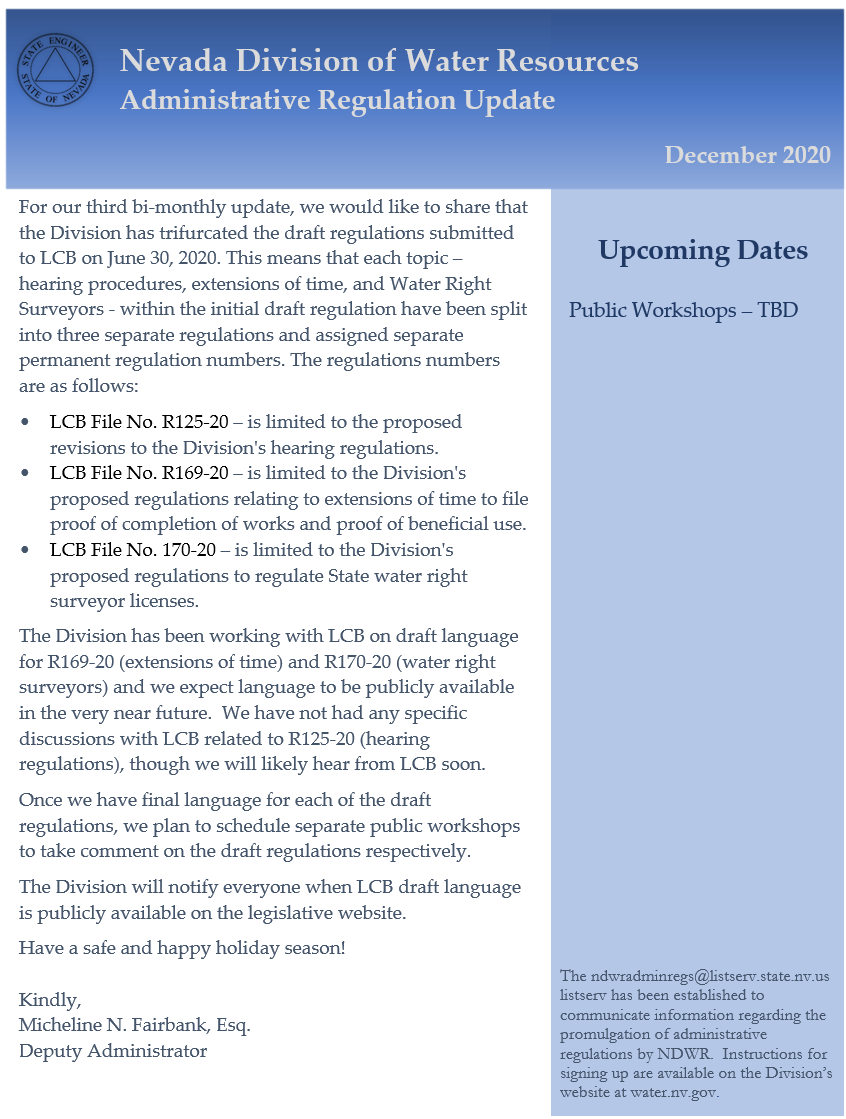
Nevada Division of Water Resources has trifurcated the draft regulations submitted to the Legislative Counsel Bureau on June 30, 2020. This means that each topic; hearing procedures, extensions of time and Water Right Surveyors within the initial draft regulation have been split into three separate regulations. Click here to read the full December update from DWR.
Nevada State Engineer Tim Wilson to retire November 30th, Adam Sullivan appointed Acting State Engineer
CARSON CITY, Nev. – After 25 years of dedicated public service to the State of Nevada, State Engineer Tim Wilson will retire on Monday, November 30, 2020. Wilson was appointed State Engineer in December 2019, having served as Acting State Engineer since January 2019. During his esteemed career with the Nevada Division of Water Resources (NDWR), Wilson served as Hydraulic Engineer, Administrative Hearing Officer, Manager of the Well Drilling and Adjudication Section, Deputy Administrator, and many other functions. As Nevada’s top water regulator, Wilson proactively addressed many of Nevada’s most pressing water resource issues, and collaborated with numerous water right surveyors, contractors, professionals, researchers, attorneys, and regulators on a wide variety of water issues across the State.
Following Wilson’s retirement, current NDWR Deputy Administrator, Adam Sullivan, will serve as Acting State Engineer and Administrator of NDWR. Sullivan has been with NDWR since 2009 and has served as Deputy Administrator since 2018. He is a licensed Professional Engineer with a Master’s degree in Hydrology from the University of Nevada, Reno, and has worked on Nevada water resource issues for over 20 years. In his new role, Sullivan will continue addressing the many critical water quantity issues and policies that affect all Nevadans, including the increasing demand for limited water resources, proactive management of over-appropriated and over-pumped groundwater basins, impacts of floods and prolonged drought, enhancing dam safety, and sustainment of our wetlands and freshwater ecosystems; all within the over-arching context of Nevada’s growing population and the current and future impacts of climate change already being felt throughout Nevada.
Nevada Governor Steve Sisolak expressed appreciation for Mr. Wilson’s service and support for Mr. Sullivan’s new role. “I thank Tim for his deep knowledge and dedicated service to address the many complex and critical watermanagement issues that affect all Nevadans. Water is Nevada’s most precious and limited natural resource, and my administration will continue to address our most pressing water issues in partnership with the Department of Conservation and Natural Resources and the next State Engineer. I am confident that Mr. Sullivan will continue to lead and enforce Nevada’s bedrock policies while advancing new and innovative solutions to preserve the long-term viability of Nevada’s water resources in every corner of our great state.”
Director of the Nevada Department of Conservation and Natural Resources, Bradley Crowell, echoed the Governor’s comments, adding: “I am grateful for Tim’s meritorious service to Nevada, his unparalleled water knowledge, and his thoughtful stewardship in managing our limited water resources for the benefit of all Nevadans. As the driest state in the nation, coupled with the ever-growing impacts of climate change, Nevada’s State Engineer plays a pivotal role in protecting existing water users while advancing innovative and forward-looking water management policies that ensure the integrity of Nevada’s water resources for future generations of Nevadans. I thank Tim for his steadfast leadership of the Division of Water Resources. Tim is now passing the torch to Adam, who will lead the Division’s mission to solve complex water challenges head-on, while ensuring a sustainable water future for all Nevadans. I am confident Adam will succeed in this critical undertaking.”
As part of the Nevada Department of Conservation and Natural Resources, the State Engineer’s Office / Division of Water Resources is responsible for the appropriation, adjudication and regulation of all the waters within the State, except the Colorado River. The State Engineer’s Office / NDWR also has oversight of water well drilling activities, dam safety, water planning, and floodplain management.
In Diamond Valley, farmers are looking to protect their future — and testing the limits of Nevada’s water laws
By Daniel Rothberg, The Nevada Independent – October 28, 2020
Across the state, regulators have issued more rights to water than there is water to go around. Water users are closely watching a test case in Diamond Valley to understand the limits of the law and the potential paths forward. Read the full article here.
DWR to hold public hearing on regulations relating to underground water and wells, well drillers and the drilling of wells on Dec. 1st
The Nevada Division of Water Resources will hold a public hearing on December 1, 2020 at 2:00 p.m. to receive comments from all interested persons regarding the Adoption of regulations that pertain to chapter 534 of the Nevada Administrative Code. This meeting will be held via videoconference/teleconference only.
The proposed regulation relating to water; revising provisions
relating to underground water and wells, well drillers and the drilling of wells. The amendments include:
a. Definitions;
b. Licensing, renewal and examination procedures;
c. Continuing education requirements;
d. License reinstatement procedure;
e. Limited licenses;
f. Duties of well drillers in designated and non-designated basins;
g. Drilling of domestic wells;
h. Notice of Intents to drill/plug a well and well driller reports;
i. Responsibilities of drillers at well drilling sites;
j. Drilling, construction and pluggings of water wells, monitoring wells and boreholes;
k. Waivers; and
l. Enforcement of the regulations and statutes.
In correcting misappropriation of water, state must balance legal rights with existing use
DANIEL ROTHBERG The Nevada Independent OCTOBER 4TH, 2020
The situation playing out along the Muddy River is not unique across the Southwest and in the Colorado River Basin. As climate change and overuse reduce water supplies, the gap between “paper water” (the legal right to use water) and “actual water” (what’s available) is widening. FULL STORY
Nevada Supreme Court Says State Cannot Change Water Rights For ‘Public Trust’
By Nevada Independent, Sep 18, 2020 10:21 am PT
The Nevada Supreme Court ruled Thursday that the state cannot reshuffle existing water rights to prevent environmental damage, despite recognizing a legal principle that requires the government to preserve natural resources for future generations.
Instead, the court ruled that principle, known as the public trust doctrine, is recognized in existing law. The Nevada court, in a 4-2 decision, separated itself from the California Supreme Court, which reached the opposite conclusion in a landmark 1980s case.
Effectively, the court found that the system that underpins Nevada’s water law, known as the doctrine of prior appropriation, is meant to take the public interest into account by defining how water can be used and by placing guardrails to prevent waste or overuse in times of scarcity. Allowing reallocation, the court said, “would create uncertainties for future development.”
The decision deals with litigation on the Walker River, which rises in eastern California and flows into western Nevada, ending at Walker Lake, a terminal desert lake in Mineral County. Along the way, water is removed from the river for farming and ranching operations. As more and more water was used over the past century, the lake shrunk and its water chemistry changed.
Walker Lake became increasingly inhospitable for fishing, boating and recreation, harming the local economy of Hawthorne, the small Mineral County town located near the lake. In 1994, the county took the issue to court. It intervened in an ongoing case to assert a “public trust” claim, asking the court to do what existing water law had not: require that a minimum flow reach the lake.
“The public trust doctrine is something that transcends statutory law,” said Simeon Herskovits, an attorney for the Walker Lake Working Group, an organization of Mineral County residents.
Although the opinion recognizes that the public trust doctrine applies “to all waters of the state, whether navigable or non-navigable,” it says the state cannot reshuffle existing water rights to meet its responsibilities. Those responsibilities are instead met through existing statute.
“We recognize the tragic decline of Walker Lake,” Justice Lidia Stiglich wrote. “But while we are sympathetic to the plight of Walker Lake and the resulting negative impacts on the wildlife, resources, and economy in Mineral County, we cannot use the public trust doctrine as a tool to uproot an entire water system, particularly where finality is firmly rooted in our statutes.”
Justices Elissa Cadish, Mark Gibbons and James Hardesty joined the majority opinion. Justice Ron Parraguirre voluntarily recused himself from the decision.
The ruling marks a significant loss for environmentalists who view the public trust doctrine as a pathway for carving out greater protections for the environment and recreation in a legal system where water is often appropriated to private interests with little left to spare for anything else.
“This says we’ve got a public trust doctrine and it applies everywhere,” said Bret Birdsong, an environmental law professor at UNLV who filed a brief in the case. “Only it means nothing.”
The decision, Birdsong argued, relegated the public trust doctrine, what is meant to be a broad legal principle, to a set of statutory tools that have not always protected resources long-term.
“It’s a bad decision for the environment,” he added.
In a dissent, Chief Justice Kristina Pickering criticized the majority interpretation, writing that it could mean “there is no remedy or action to be taken to protect from the irreversible depletion of this state’s most precious natural resource,” as long as the state engineer fulfills his statutory role.
Justice Abbi Silver joined Pickering in the dissent.
The issue came before the Nevada Supreme Court after the 9th Circuit Court of Appeals was weighing Mineral County’s public trust claim. In 2018, the appellate court asked the Nevada Supreme Court to define the scope of the public trust doctrine as it is applied to the state’s water rights system. The case then became about much more than Walker Lake.
Water users across the state — cities, counties and tribes — became involved, filing briefs with the Supreme Court. Industry groups for miners, ranchers and farmers similarly filed briefs. Most argued against the reallocation of existing water rights, considered a property right.
On Thursday, the court ruled that water rights cannot be reallocated unless provided by statute.
Rod Walston, an attorney for Lyon County and Centennial Livestock, applauded the ruling and noted that it could have broader implications for other Western states, where courts are still weighing the scope of the public trust doctrine in the context of existing water allocations.
“Until this decision today, only one [state] Supreme Court had dealt with this,” Walston said.
In a 1983 case involving the Los Angeles Department of Water and Power’s diversion of water away from Mono Lake, the California Supreme Court affirmed that the public trust doctrine can affect existing water rights. Nevada’s recent decision marks a stark contrast to that ruling.
Pickering’s dissent, which cited the Mono Lake case, argued that the public trust doctrine was a distinct element of law that evolved separate from statute and should be considered in balance.
The statutory framework, Pickering said, does not always fully account for public trust values.
“For example, while it could theoretically be in the public interest to allocate water rights to facilitate cattle grazing, increase herd size, and ultimately reduce the price of beef for dinner, if done without regard to the deleterious impacts of unsustainable water and grazing on Nevada’s natural resources, such action could also be entirely inconsistent with public trust principles,” she wrote.
She added that Mineral County’s public trust claim might not necessarily affect existing rights. The county sought “a range of relief” that could “take a number of different forms,” including irrigation efficiency, a state-led plan and changing how water is managed in wet years.
“Crediting Mineral County’s position with respect to the public trust doctrine does not require that the decree court revoke senior adjudicated Walker Basin water rights,” Pickering wrote.
In a footnote, the majority disagreed with this interpretation of the case. The footnote argued that “the underlying dispute involves demands for over-appropriated resources that require determining whether water rights may be reallocated from current rights holders.”
Herskovits said the decision could make it harder to bring a public trust claim in the future.
“The majority opinion creates a precedent that will make it extremely difficult for any individual citizens or citizens organizations to bring an action challenging whether or not the public trust duty or obligation has been fulfilled by the state,” Herskovits said in a phone interview.
“It is very significant and it has tremendous implications for the state,” he added.
The Nevada Supreme Court Ruling can be found here.